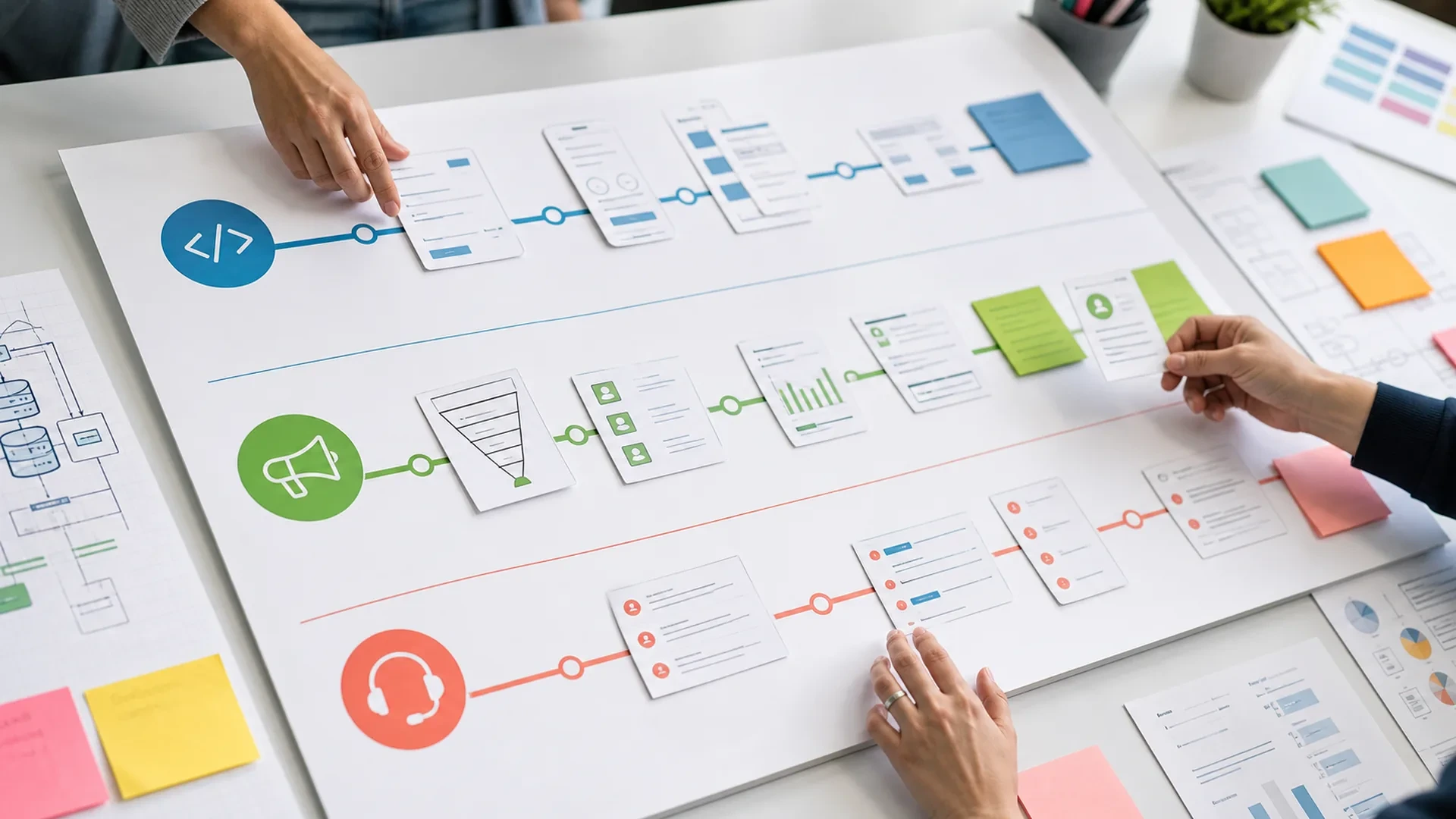
How a digital roadmap connects software, marketing, and support
A business can have a website, social media activity, forms, spreadsheets, software subscriptions, internal tools, and support needs, but still feel disconnected.
That happens when each digital piece is handled separately.
Marketing may bring attention, but the website may not guide visitors clearly. Forms may collect information, but the team may not have a consistent follow-up process. A tool may store data, but reporting may still require manual work. A platform may exist, but it may not be maintained or improved over time.
A digital roadmap helps connect those pieces into a practical plan.
It gives the business a way to decide what should happen first, what can wait, what needs to be connected, and what should be supported after launch.
Why digital work often becomes disconnected
Digital growth often happens in pieces.
A business builds a website. Later, it starts running ads. Then it adds a CRM, a scheduling tool, forms, email marketing, internal spreadsheets, or an app. Each decision may make sense in the moment.
The problem appears when the pieces do not work together.
Common signs include:
Marketing campaigns send traffic to pages that are not ready to convert.
Leads arrive, but follow-up depends on memory or manual notes.
Customer information lives in several systems.
Reports take too much time to prepare.
The website does not connect to the sales or service workflow.
Internal tools solve one issue but create another.
A platform is launched but not maintained consistently.
The business does not always need more technology. It may need a roadmap that connects the technology it already has with the next improvements it should make.
What a digital roadmap should include
A digital roadmap should organize the work around business priorities.
It does not need to be complicated, but it should answer practical questions.
The business goal
Start with the outcome.
Is the business trying to capture better inquiries, reduce manual work, improve reporting, support customers faster, modernize an existing platform, or prepare for growth?
The roadmap should connect every technical decision to a business goal.
The current workflow
Before adding a new tool, the business should understand how work happens today.
Where does information enter? Who uses it? What happens next? Where does the process slow down?
This helps prevent software, automation, or marketing work from being built around an unclear process.
The priority order
Not every improvement should happen at once.
The roadmap should identify:
What needs to happen first.
What depends on another step.
What can be improved later.
What should stay simple.
What needs support after launch.
This makes the work easier to plan and measure.
How software fits into the roadmap
Software can be part of the roadmap when the business needs a better way to manage a workflow.
That may include:
A custom web application.
A mobile app for employees or customers.
An internal dashboard.
A customer portal.
Automation between tools.
A reporting system.
A platform that organizes tasks, requests, leads, or projects.
Custom software is most useful when the process is specific, repeatable, and difficult to manage with generic tools.
But software should not be isolated from the rest of the business. A dashboard is more useful when the right data enters the system. A portal is more useful when customers know how to use it. An internal tool is more useful when it connects to real responsibilities and reporting.
The roadmap keeps software connected to the workflow.
How marketing fits into the roadmap
Marketing should also be part of the roadmap because visibility alone is not enough.
A business may publish content, run ads, or post on social media, but those efforts work better when they connect to:
Clear service pages.
Landing pages that match the message.
Forms that collect useful information.
Tracking that shows where inquiries come from.
Follow-up workflows.
Reporting that helps the team improve.
If marketing and operations are disconnected, the business may get attention without clarity.
The roadmap should define how someone moves from first contact to next step.
Why support belongs in the plan
Support is often treated as something that happens after a project is finished.
But support should be part of the roadmap from the beginning.
Websites, applications, automations, and platforms need updates, monitoring, adjustments, security awareness, and improvements over time.
Support can include:
Fixing issues.
Updating content or features.
Improving performance.
Monitoring forms and integrations.
Maintaining technical stability.
Reviewing analytics and behavior.
Planning future improvements.
A digital roadmap should not end at launch. It should include how the system will stay useful.
How Exeditec can help
Exeditec helps businesses plan and build digital systems that connect software, web platforms, automation, marketing, AI-supported workflows, and support.
The objective is to create a practical sequence, not a disconnected list of tools.
Depending on the business, the roadmap may begin with a website improvement, a digital assessment, a custom system, tracking setup, automation, maintenance, or a phased plan for future development.
If your business is trying to connect software, marketing, and support into one clearer strategy, a roadmap can help define the next step and the steps after that.